
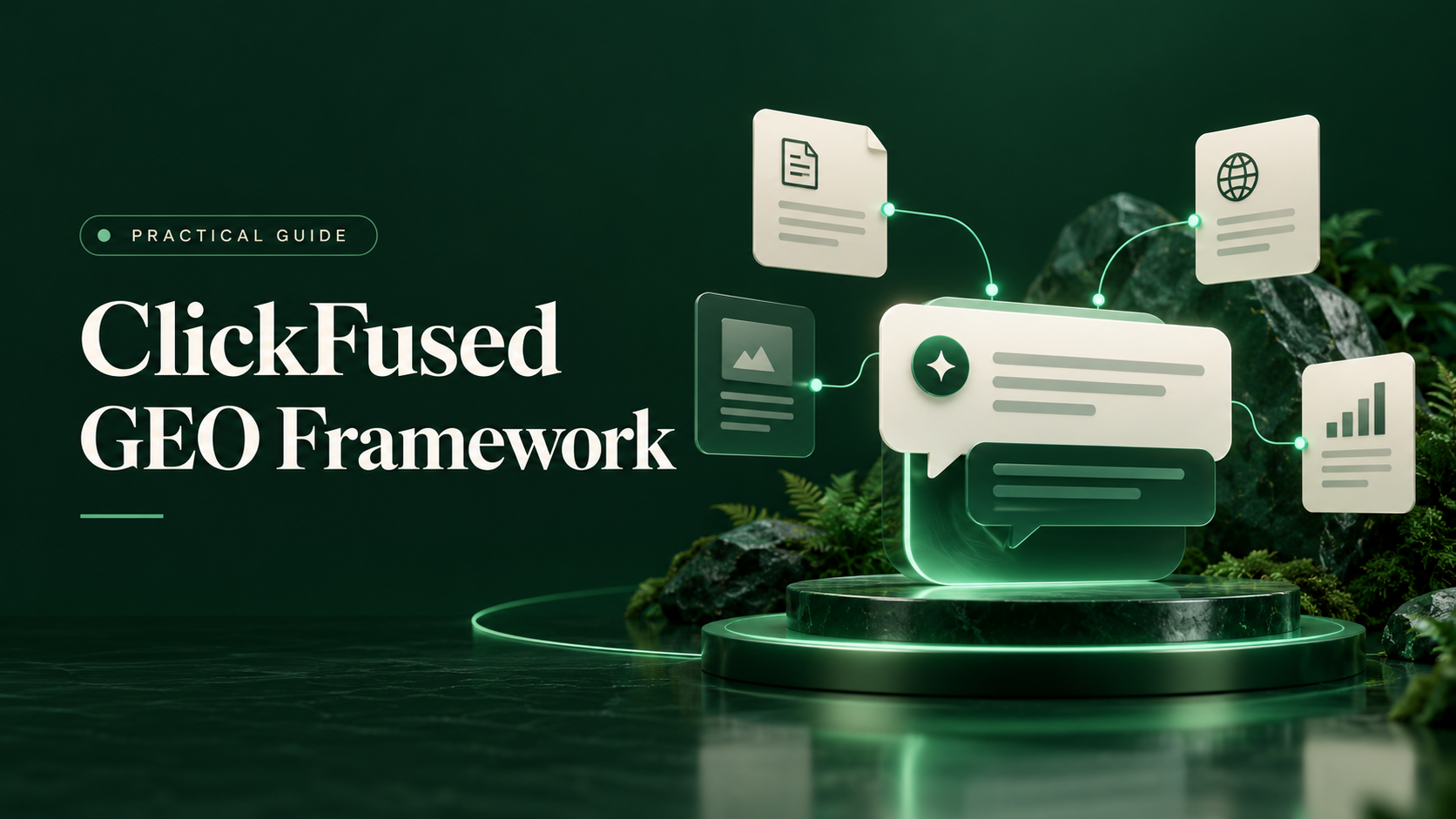
ClickFused GEO Framework: Improve how your business can be understood and checked during conversational discovery. The ClickFused GEO workflow links useful answers, clear entities, evidence and a repeatable observation method across search-enabled assistants.
For teams studying generative engine optimisation across multiple providers. Provider behaviour differs; this is an editorial and measurement process, not a way to control an assistant’s recommendations.
Before you start
- Verified business facts and service scope
- A shortlist of real customer questions
- Access to the specific assistants you intend to observe
Step 1: Build the evidence register
Write the business name, services, service area, people and approved source URLs. For each fact, name an owner and review date. Resolve conflicting phone numbers or claims before rewriting pages. Keep company-published information distinct from independent evidence.
Keep this output: A factual register the writer can actually check.
Step 2: Choose useful conversational tasks
Map discovery, comparison and action questions. A prospect asking how to choose a provider needs criteria and trade-offs, not ten copies of a brand slogan. Give each substantive task one appropriate page and link it to related supporting material.
Keep this output: A task-to-page map without unnecessary duplicates.
Step 3: Create source-ready explanations
Explain what the service includes, who it suits and when it is unsuitable. Provide attributable examples or a transparent method. Google’s people-first guidance values useful, original contribution; our editorial recommendation is to make the supporting evidence easy to inspect.
Keep this output: A page that helps even if no assistant cites it.
Step 4: Check retrieval access by provider
Review the current crawler documentation for each provider you target. Search retrieval, model training and user-triggered fetching are different mechanisms. OpenAI documents separate search and training controls; do not generalise those details to every assistant. Record approved access decisions with the technical owner.
Keep this output: A provider-specific access checklist.
Step 5: Measure answers and citations separately
Use the same unbranded question set, note the assistant, model if shown, date and search mode. Record brand mentions, citations, factual errors and useful referral visits separately. A prompted brand mention is not evidence of unprompted discovery.
Keep this output: A comparable observation log with retained evidence.
A worked example
Illustrative task: a buyer asks what to check before hiring a local SEO agency. A useful page explains deliverables, access requirements, reporting limits and evaluation questions. If your own business is named in a comparison, disclose the relationship and do not invent competitors’ prices or results.
Copy-and-paste prompt pack
Copy one prompt below into your preferred assistant. Replace the square-bracket inputs with approved facts or anonymised data. Review the answer against its sources before using it; these prompts prepare decisions and do not execute account changes.
Prompt 1: Map conversational needs
Using these anonymised customer questions [paste] and verified service facts [paste], group questions by discovery, comparison and action. Recommend the right page type and evidence needed. Merge substantially identical tasks; do not invent query demand.Prompt 2: Review entity consistency
Compare these page excerpts [paste]. Find inconsistent business names, services, people, locations and scope. Return the conflicting text and the fact that must be verified. Do not decide an unknown fact by majority vote.Prompt 3: Score an observed answer
Question: [paste]. Exact assistant answer and cited URLs: [paste]. Approved facts: [paste]. Label each material claim supported, contradicted or unresolved. Separate a brand mention from a citation and a useful recommendation. No inferred ranking or visibility percentage.The improvement loop
Collect questions → publish useful evidence → observe the fixed question set → correct a demonstrated information gap → repeat. Change one meaningful page issue at a time; assistant variation limits causal conclusions.
Practical tips and troubleshooting
- Use a fixed unbranded question set for discovery checks.
- Keep “not observed” distinct from “proven absent”.
- Prefer genuine references and accurate profiles over manufactured mentions.
Validation checklist
- Business facts are consistent and attributable.
- Each page solves a distinct conversational task.
- Provider-specific access rules were checked.
- Observation methods and limitations are recorded.
GitHub tooling and a reference screenshot
Promptfoo ↗. An open-source evaluation project for prompts and model outputs. It can help developers make their own checks repeatable. API evaluations are not a substitute for observing a consumer search interface.

Sources and further reading
Platform guidance checked on 26 October 2026. Account interfaces and provider behaviour can change; inspect the current documentation before implementing a technical change.
Choose your next guide
Use the ClickFused SEO Framework for the shared planning foundation, then choose the workflow that matches your next task:
- ClickFused Meta Ads Framework
- ClickFused Google Ads Framework
- ClickFused AIO Framework
- ClickFused AI SEO Framework
- ClickFused LLMO Framework
Need help applying the checklist to your own evidence? Contact ClickFused with the page or campaign scope you want reviewed.